
NVIDIA AI Introduces PivotRL: A New AI Framework Achieving High Agentic Accuracy With 4x Fewer Rollout Turns Efficiently
Post-training Large Language Models (LLMs) for long-horizon agentic tasks—such as software engineering, web browsing, and complex tool use—presents a persistent trade-off between computational efficiency and model generalization. While Supervised Fine-Tuning (SFT) is computationally inexpensive, it frequently suffers from out-of-domain (OOD) performance degradation and struggles to generalize beyond its training distribution. Conversely, end-to-end reinforcement learning (E2E RL) typically preserves OOD capabilities and achieves high in-domain accuracy, but it incurs massive compute costs due to the necessity of repeated, many-turn on-policy rollouts for every parameter update.
NVIDIA researchers have introduced PivotRL, a framework designed to bridge this gap. By operating on existing SFT trajectories, PivotRL aims to deliver the generalization benefits of E2E RL while maintaining the data efficiency associated with SFT.
The Architecture of a Pivot
The core of PivotRL is the transition from full-trajectory rollouts to targeted, turn-level updates. The framework identifies and utilizes two primary mechanisms: Pivot Filtering and Functional Rewards.
1. Pivot Filtering
In turn-level agentic training, every assistant completion at a model-call boundary is considered an action. PivotRL begins by extracting all assistant turns from an SFT dataset into a ‘pivot candidate’ pool.

The system then profiles these candidates offline using a frozen reference policy, π0. To optimize the training budget, PivotRL filters for pivots: specific states where local, on-policy rollouts exhibit high variance in outcomes. The filtering criteria are defined by two conditions:
Nonzero empirical reward variance: σ^2(s)>0\hat{\sigma}^2(s) > 0.
Low reward mean: μ^(s)<λdiff\hat{\mu}(s) < \lambda_{diff}
This approach addresses the uninformative-turn bottleneck. In group-normalized RL—specifically Group Relative Policy Optimization (GRPO)—turns where actions either uniformly succeed or uniformly fail result in a normalized advantage of zero, providing no meaningful gradient update. By focusing on mixed-outcome turns that remain difficult for the reference policy, PivotRL concentrates compute on states that provide the strongest learning signal.
2. Implementing Functional Rewards
Standard SFT-to-RL adaptations often rely on exact string matching with the demonstration data to assign rewards. However, in generative action spaces (e.g., shell commands or search queries), multiple functionally equivalent actions may diverge from the specific string in the training data.
PivotRL replaces strict matching with functional rewards, rfunc(s,a)=1[a∈ℳ(s)]r_{func}(s, a) = 1[a \in \mathcal{M}(s)], where ℳ(s)\mathcal{M}(s) is the set of locally acceptable actions determined by a domain-specific verifier. These verifiers can range from normalized schema checks and string similarity to lightweight LLM-as-a-judge scoring.
Theoretical Foundations: Gradient Signal and OOD Retention
The effectiveness of these design choices is supported by two primary theoretical results:
Theorem 3.2 (Reward Variance and GRPO Signal): The research team proved that the Fisher norm of the natural gradient of the statewise reward objective scales with the reward standard deviation. Specifically, the population GRPO score, γs,β,equalsσβ2\gamma_{s, \beta}, equals \frac{\sigma}{\beta^2}. This validates the strategy of filtering for mixed-outcome pivots to maximize the local in-domain learning signal.
Theorem 3.3 (Minimal KL Change): This theorem demonstrates that functional reward-based RL shifts probability mass toward acceptable actions while preserving the reference policy’s relative probability ordering for actions unrelated to the training task. Because the relative ranking of task-unrelated actions remains unchanged, PivotRL significantly mitigates the catastrophic forgetting and OOD degradation common in SFT.
Performance and Efficiency
The research team evaluated PivotRL using Qwen3-30B-A3B-Thinking-2507 as the base model across four agentic domains: conversational tool use (τ2−Bench)(\tau^2-Bench), software engineering (SWE-Bench Verified), terminal control (Terminal-Bench), and web browsing (BrowseComp).
In-Domain Accuracy Gains
Compared to SFT on identical data, PivotRL achieved superior in-domain results:
Average Gain: +14.11 points over the base model, compared to +9.94 points for SFT.
Domain Specifics: PivotRL outperformed SFT on τ2−Bench\tau^2-Bench (+5.37), Terminal-Bench (+6.25), and BrowseComp (+9.80).
Out-of-Domain Retention
The most significant advantage was observed in OOD stability. While SFT caused an average regression of -9.83 across eight OOD benchmarks (including math and science QA), PivotRL maintained a near-zero average change of +0.21. Notably, PivotRL achieved +10.04% higher OOD accuracy in non-agentic tasks compared to SFT.
Compute Efficiency on SWE-Bench
On SWE-Bench Verified, a rigorous standard for long-horizon agents, PivotRL demonstrated a substantial reduction in training overhead:
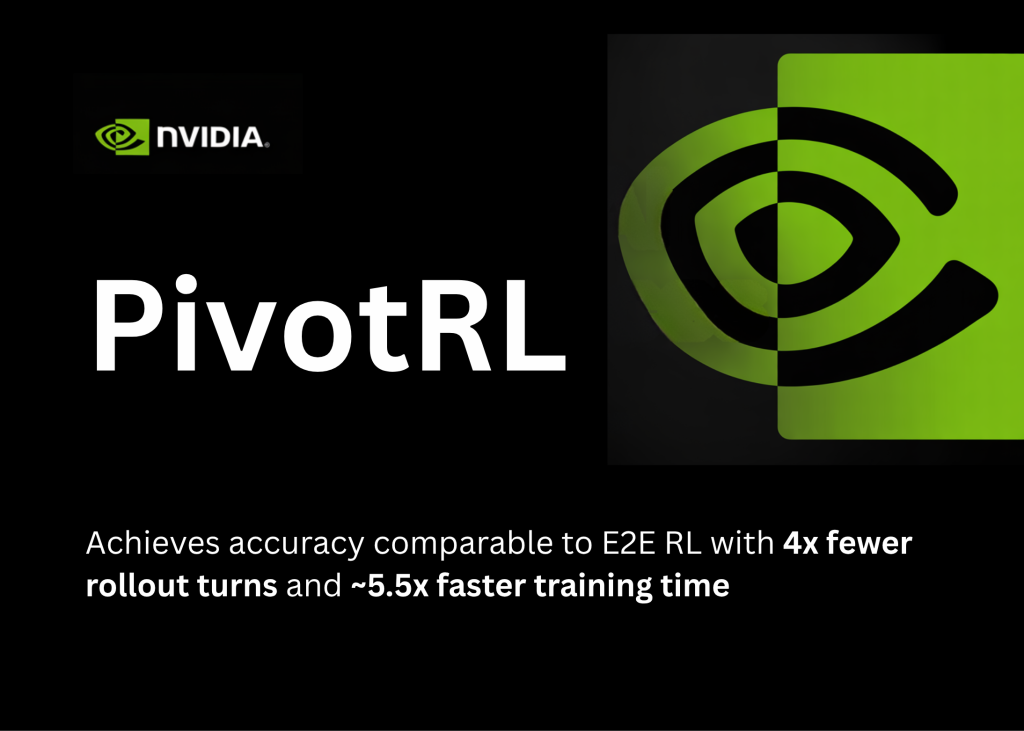
Turn Efficiency: PivotRL reached accuracy levels comparable to E2E RL using 4x fewer rollout turns.
Temporal Efficiency: Training was ~5.5x faster in wall-clock time than E2E RL when using the same number of compute nodes.
Key Takeaways
Hybrid Efficiency: PivotRL combines the compute efficiency of Supervised Fine-Tuning (SFT) with the out-of-domain (OOD) generalization of End-to-End RL.
Pivot Filtering: The framework identifies ‘pivots’—critical intermediate turns where sampled actions show high variance in success/failure, providing the strongest learning signals.
Functional Verifiers: Instead of requiring exact text matches, PivotRL uses domain-specific verifiers to reward any functionally equivalent action.
OOD Stability: Unlike SFT, PivotRL preserves the model’s performance on unrelated tasks (e.g., math) by maintaining the reference policy’s probability ordering for task-unrelated actions.
Production Speed: It achieves accuracy comparable to E2E RL with 4x fewer rollout turns and ~5.5x faster training time, as proven in NVIDIA’s Nemotron-3-Super.
Check out the Paper. Also, feel free to follow us on Twitter and don’t forget to join our 120k+ ML SubReddit and Subscribe to our Newsletter. Wait! are you on telegram? now you can join us on telegram as well.