

The Statistical Cost of Zero Padding in Convolutional Neural Networks (CNNs)
What is Zero Padding
Zero padding is a technique used in convolutional neural networks where additional pixels with a value of zero are added around the borders of an image. This allows convolutional kernels to slide over edge pixels and helps control how much the spatial dimensions of the feature map shrink after convolution. Padding is commonly used to preserve feature map size and enable deeper network architectures.

The Hidden Issue with Zero Padding
From a signal processing and statistical perspective, zero padding is not a neutral operation. Injecting zeros at the image boundaries introduces artificial discontinuities that do not exist in the original data. These sharp transitions act like strong edges, causing convolutional filters to respond to padding rather than meaningful image content. As a result, the model learns different statistics at the borders than at the center, subtly breaking translation equivariance and skewing feature activations near image edges.
How Zero Padding Alters Feature Activations
Setting up the dependencies
import matplotlib.pyplot as plt
from PIL import Image
from scipy.ndimage import correlate
from scipy.signal import convolve2d
Importing the image
img_array = np.array(img) / 255.0 # Normalize to [0, 1]
plt.imshow(img, cmap=”gray”)
plt.title(“Original Image (No Padding)”)
plt.axis(“off”)
plt.show()

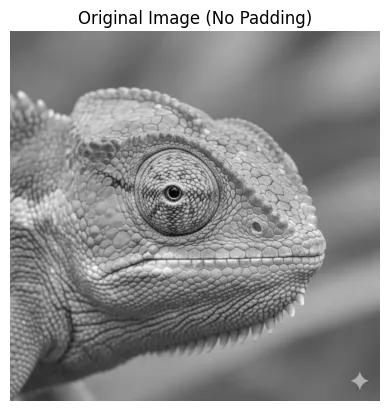
In the code above, we first load the image from disk using PIL and explicitly convert it to grayscale, since convolution and edge-detection analysis are easier to reason about in a single intensity channel. The image is then converted into a NumPy array and normalized to the [0,1][0, 1][0,1] range so that pixel values represent meaningful signal magnitudes rather than raw byte intensities. For this experiment, we use an image of a chameleon generated using Nano Banana 3, chosen because it is a real, textured object placed well within the frame—making any strong responses at the image borders clearly attributable to padding rather than true visual edges.
Padding the Image with Zeroes
padded_img = np.pad(img_array, pad_width, mode=”constant”, constant_values=0)
plt.imshow(padded_img, cmap=”gray”)
plt.title(“Zero-Padded Image”)
plt.axis(“off”)
plt.show()
In this step, we apply zero padding to the image by adding a border of fixed width around all sides using NumPy’s pad function. The parameter mode=’constant’ with constant_values=0 explicitly fills the padded region with zeros, effectively surrounding the original image with a black frame. This operation does not add new visual information; instead, it introduces a sharp intensity discontinuity at the boundary between real pixels and padded pixels.
Applying an Edge Detection Kernel
[-1, 8, -1],
[-1, -1, -1]])
# Convolve both images
edges_original = correlate(img_array, edge_kernel)
edges_padded = correlate(padded_img, edge_kernel)
Here, we use a simple Laplacian-style edge detection kernel, which is designed to respond strongly to sudden intensity changes and high-frequency signals such as edges. We apply the same kernel to both the original image and the zero-padded image using correlation. Since the filter remains unchanged, any differences in the output can be attributed solely to the padding. Strong edge responses near the borders of the padded image are not caused by real image features, but by the artificial zero-valued boundaries introduced through zero padding.
Visualizing Padding Artifacts and Distribution Shift
# Show Padded Image
axes[0, 0].imshow(padded_img, cmap=’gray’)
axes[0, 0].set_title(“Zero-Padded Image\n(Artificial ‘Frame’ added)”)
# Show Filter Response (The Step Function Problem)
axes[0, 1].imshow(edges_padded, cmap=’magma’)
axes[0, 1].set_title(“Filter Activations\n(Extreme firing at the artificial border)”)
# Show Distribution Shift
axes[1, 0].hist(img_array.ravel(), bins=50, color=”blue”, alpha=0.6, label=”Original”)
axes[1, 0].set_title(“Original Pixel Distribution”)
axes[1, 0].set_xlabel(“Intensity”)
axes[1, 1].hist(padded_img.ravel(), bins=50, color=”red”, alpha=0.6, label=”Padded”)
axes[1, 1].set_title(“Padded Pixel Distribution\n(Massive spike at 0.0)”)
axes[1, 1].set_xlabel(“Intensity”)
plt.tight_layout()
plt.show()

In the top-left, the zero-padded image shows a uniform black frame added around the original chameleon image. This frame does not come from the data itself—it is an artificial construct introduced purely for architectural convenience. In the top-right, the edge filter response reveals the consequence: despite no real semantic edges at the image boundary, the filter fires strongly along the padded border. This happens because the transition from real pixel values to zero creates a sharp step function, which edge detectors are explicitly designed to amplify.
The bottom row highlights the deeper statistical issue. The histogram of the original image shows a smooth, natural distribution of pixel intensities. In contrast, the padded image distribution exhibits a massive spike at intensity 0.0, representing the injected zero-valued pixels. This spike indicates a clear distribution shift introduced by padding alone.
Conclusion
Zero padding may look like a harmless architectural choice, but it quietly injects strong assumptions into the data. By placing zeros next to real pixel values, it creates artificial step functions that convolutional filters interpret as meaningful edges. Over time, the model begins to associate borders with specific patterns—introducing spatial bias and breaking the core promise of translation equivariance.
More importantly, zero padding alters the statistical distribution at the image boundaries, causing edge pixels to follow a different activation regime than interior pixels. From a signal processing perspective, this is not a minor detail but a structural distortion.
For production-grade systems, padding strategies such as reflection or replication are often preferred, as they preserve statistical continuity at the boundaries and prevent the model from learning artifacts that never existed in the original data.

I am a Civil Engineering Graduate (2022) from Jamia Millia Islamia, New Delhi, and I have a keen interest in Data Science, especially Neural Networks and their application in various areas.