
OpenAI and Cisco Releases Shirudo: An Open-Source Linux Runtime Allowing Agents to Defend Systems Without Downtime
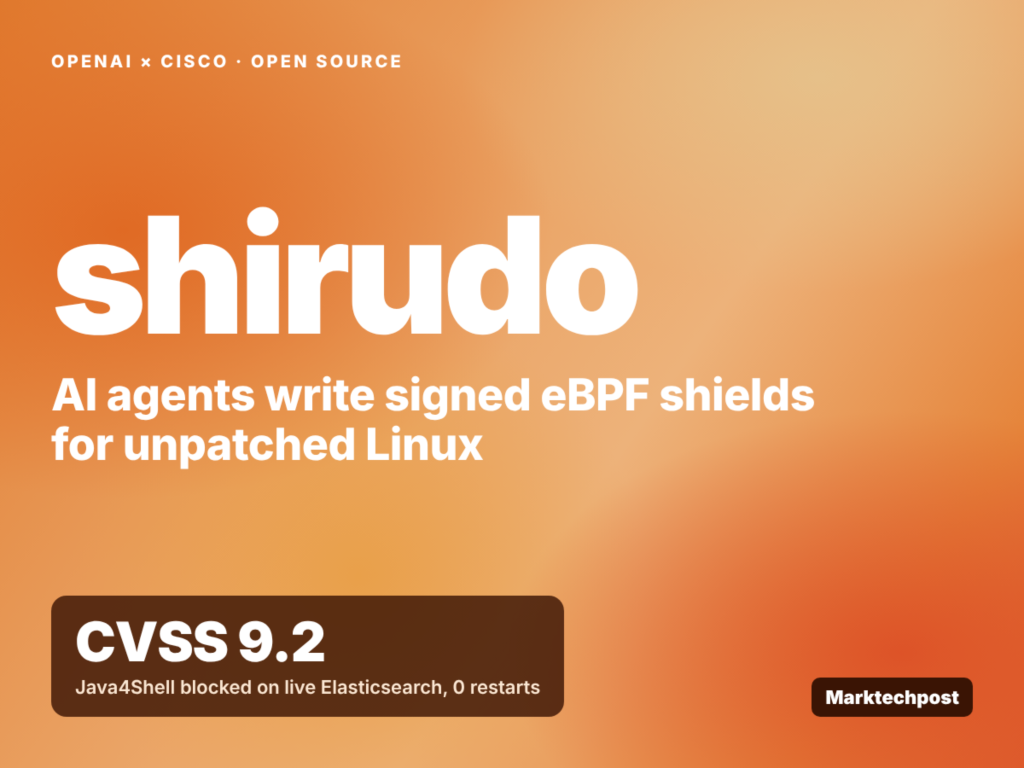
OpenAI and Cisco have released Shirudo, an open-source Linux runtime for defending live systems. Shirudo is an eBPF runtime that lets AI agents write temporary “shields” against known exploits. Shields block the vulnerable behavior while legitimate requests keep flowing. Teams get time to test and ship the real patch. The engineering came from Isovalent at Cisco, the team behind Cilium and Tetragon.
TL;DR
Size: Software runtime, not a model. Code is pre-release.
Runs on: Linux on x86-64, arm64 and riscv64, with TPM 2.0 and a patched bpf-next kernel. The quickstart VM example uses 4 CPUs and 4G RAM.
Performance: No overhead or latency numbers published. One controlled exploit test is disclosed.

Best: A Codex-generated shield blocked Java4Shell (CVSS 9.2) on running Elasticsearch 9.5.5, with no restart.
Worst: Targets need a bpf-next kernel plus 5 carried patches not yet in bpf-next. No TPM-less mode.
Bottom line: Best: signed, TPM-attested mitigations agents can write in code.
What problem does Shirudo solve?
Patching takes time. OpenAI team notes that testing and deploying a fix can take days or weeks. Blocking a whole Linux operation is risky, because exploits and normal requests often share it. Shirudo targets that patch window.
How does Shirudo work?
Shirudo uses eBPF, which runs small verified programs at hooks inside the Linux kernel. The name is Japanese for “shield.” Isovalent calls it a rewrite of Tetragon, its 2022 eBPF security platform.
The design splits work across 2 roles:
Operator machine: a one-shot CLI, not a daemon. It builds and signs shields, then pushes them to an OCI registry. Signing code never reaches a target.
Target node: no persistent Shirudo daemon. Its control plane is an eBPF program loaded at boot. It pulls packages and verifies signatures before loading them.
A shield can do 3 things. It can block the code path a bug needs, replace vulnerable code, or add detection visibility. The docs call these packages upatches: small BPF C programs shipped as signed artifacts.
There is deliberately no policy DSL. The Linux Plumbers talk by Daniel Borkmann and John Fastabend says agents work better with code directly.
What does the agent loop look like?
Isovalent describes 4 stages, with Codex as the control plane:
Discovery: find bugs or ingest external disclosures.
Mitigation: build an exploit reproducer, pick a hook, and iterate until the shield works.
Rollout: push signed shields, monitored against a security score and app health.
Monitoring: a hit count tracks exploitation attempts against shielded bugs.
Operators approve shields before enforcement. Teams can also observe a shield’s impact before it blocks anything.
How is trust enforced?
The kernel checks each loader’s signature against a .bpf keyring. The eBPF verifier then checks program safety. A TPM 2.0 records every load and unload, and signs attestation evidence. The test bundle uses an ML-DSA-87 signing key, a post-quantum algorithm. Registry traffic uses TLS 1.3 with hybrid post-quantum key exchange.
How did Shirudo perform against Java4Shell?
Java4Shell (CVE-2026-114938) is a heap corruption bug in OpenJDK’s Base64 decoder. It scores 9.2 on CVSS 4.0. It affects OpenJDK 17.0.6 and newer on x86-64 CPUs with AVX-512 VBMI. Calif.io found it on October 24 using Codex. Oracle shipped a fix on November 17.
Codex generated a guard on java.util.Base64$Decoder.decode0. It was attached to a running Elasticsearch 9.5.5 node. The exploit input was rejected and the service stayed up. That is the only disclosed test. No false-positive rate or overhead figure was published.
Source note: OpenAI frames shields as eBPF. The Isovalent post says this specific shield was Java bytecode. The Java agent docs call such upatches an in-application mitigation, not a kernel boundary. Those docs also describe startup-time loading only, while the demo attached at runtime.
What do you need to run Shirudo?
Requirements are strict. Per the system requirements page:
A bpf-next kernel with the signed-loader ABI. The test kernel reports 7.4.0-rc1-bpf-next+.
5 carried kernel patches, none in bpf-next yet.
TPM 2.0, systemd 256 or newer, and a unified kernel image.
Operator: clang and LLVM 23, plus OpenSSL 3.5 or newer.
There is no fallback for older kernels. Developers can try the VM quickstart or the Isovalent lab.
Key Takeaways
Shirudo lets AI agents write signed eBPF shields for live Linux systems.
A Codex-built guard blocked Java4Shell (CVSS 9.2) on running Elasticsearch.
Every load is signature-checked and recorded by TPM 2.0.
Targets need a patched bpf-next kernel today.
No overhead or false-positive data is published yet.
Check out the OpenAI announcement, Isovalent technical post, GitHub repo and docs. You can check the deployment options and specs here through our GPULeaderboard.com chrome extension.
Also, feel free to follow us on Twitter and don’t forget to join our 150k+ML SubReddit and Subscribe to our Newsletter. Wait! are you on telegram? now you can join us on telegram as well.
Need to partner with us for promoting your GitHub Repo OR Hugging Face Page OR Product Release OR Webinar etc.? Connect with us
Asif Razzaq is the CEO of Marktechpost AI Media Inc.. As a visionary entrepreneur and engineer, Asif is committed to harnessing the potential of Artificial Intelligence for social good. His most recent endeavor is the launch of an Artificial Intelligence Media Platform, Marktechpost, which stands out for its in-depth coverage of machine learning and deep learning news that is both technically sound and easily understandable by a wide audience. The platform boasts of over 2 million monthly views, illustrating its popularity among audiences.